



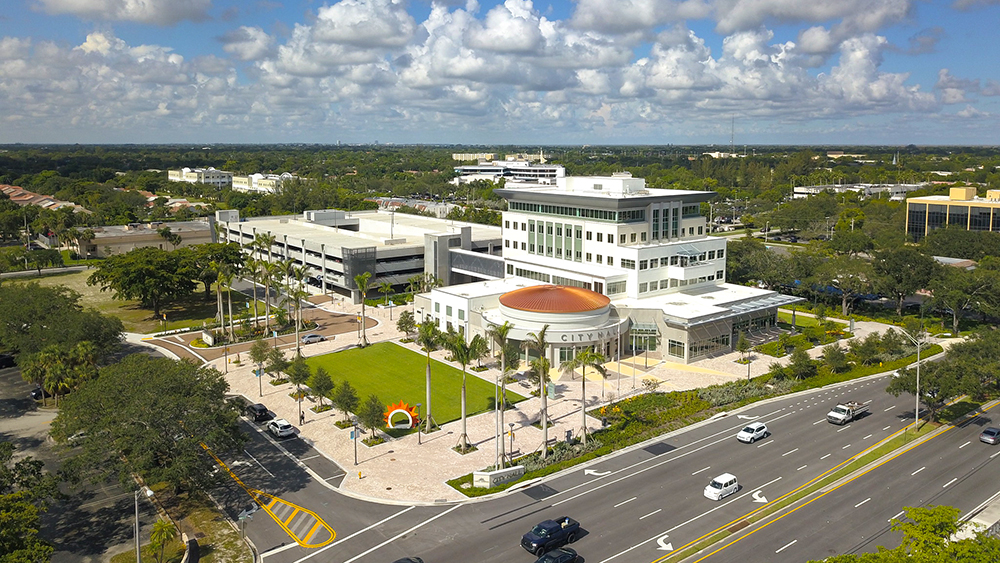
City Hall {City of Coral Springs}
Coral Springs officials warned residents Tuesday that a statewide property tax amendment on the November ballot could leave the city facing an annual revenue shortfall approaching $27 million once fully implemented, potentially forcing cuts to city services.
The warning came during a public forum at City Hall devoted to Amendment 3, where city administrators walked residents through Coral Springs’ budget and used live polling to gauge which services residents consider most important and which they would be most willing to cut.
City Manager Catherine Givens stressed that Coral Springs has made no decisions about raising taxes, increasing fees, or reducing services if the amendment passes.

“There has been no decision made,” Givens said. “Right now, we are in a period where we are trying to educate.”
Amendment 3, officially titled “Increased Homestead Exemption; Lower Cap on Increases in Non-Homestead Property Assessments,” will appear on Florida’s November 3 general election ballot. It would increase the homestead exemption for non-school property taxes to $150,000 in 2027 and $250,000 in 2028, with inflation adjustments afterward. It would also lower the annual assessment-increase cap on non-homestead properties from 10% to 5% and make other changes governing local property-tax collections and spending. School district taxes are excluded from the increased exemption.

The amendment requires approval from at least 60% of Florida voters. If passed, it would not change Florida’s existing Save Our Homes cap on annual assessment increases for homesteaded properties, or the ability of homeowners to transfer that tax benefit when moving to another Florida homestead.
Coral Springs officials estimate the amendment would reduce annual property-tax revenue by approximately $14.55 million during its first phase and approximately $26.85 million once the higher exemption is implemented.
Budget and Sustainability Director Ileana Kyriakides told residents at Tuesday’s meeting that the city receives just under 30% of the ad valorem taxes appearing on a typical Coral Springs property-tax bill, with the remainder going primarily to the Broward County School Board, Broward County, and several smaller taxing authorities.
Kyriakides said property taxes currently account for about 47.8% of city revenues. Police and emergency medical services, meanwhile, account for roughly 47.4% of city expenses.
She said the city is working with a proposed $201.6 million budget and approximately $96.5 million in ad valorem revenue. Under the city’s projections, the amendment would create a roughly $14.5 million gap during its first phase and a nearly $27 million gap after the exemption increases again.
Givens said the city’s police department is projected to cost about $75 million in the coming budget year, while emergency medical services account for roughly another $20 million.
That means police and EMS alone would consume nearly all of the city’s current property-tax revenue before the amendment’s projected reductions, she said.
“If we have $95 million that I just added up, the 75 plus 20,” Givens said, “by year two, ad valorem dollars on this cut will not be able to” cover both services without other funding.
City officials laid out several possibilities for closing a future budget gap, including adjustments to the millage rate, higher user fees, increased special assessments, additional public-private partnerships, naming-rights agreements, and reductions in service levels.
Givens said those possibilities were being presented to residents for discussion, not as a plan.
“I have not at present been told that I need to reduce service levels,” she said.
The city also cautioned against relying on reserves to cover recurring expenses. Kyriakides said Coral Springs maintains emergency reserves, but described those funds as intended to protect the city during disasters and other emergencies.
Residents were asked at the forum to rank city services and identify areas they would consider reducing if cuts became necessary.
Public safety and emergency services emerged as the highest priority among participants, followed by issues that included street maintenance, infrastructure, community aesthetics, and quality of life.
When residents were asked about potential reductions in arts and cultural spending, 72% of respondents selected cultural programming as an area they would consider cutting, while 45% chose historical preservation and education and 43% selected the Coral Springs Museum of Art.
Among communications-related services, 63% selected the city’s Under the Sun magazine for possible reductions, while 43% selected city branding efforts such as signage and entryway banners.
For parks and recreation, 65% of respondents identified events such as Thrills and Chills and Family Fun Night as potential areas for reduction, while 36% selected recreational programming. Participants were allowed to choose more than one response, meaning the percentages were not intended to total 100%.
Givens also highlighted services that are not legally required but that city officials believe distinguish Coral Springs from other communities. Those included the police department’s Humane Unit, community outreach programs, and the city’s school resource officer program.
The city has 24 officers assigned to schools, Givens said, with Broward County Public Schools reimbursing Coral Springs for part of the program’s cost.
Democratic state Reps. Dan Daley and Christine Hunschofsky, who represent Coral Springs and attended the resident forum, said they opposed Amendment 3 and criticized the process used by the Legislature to place it on the ballot.
Daley said he supports discussing property-tax reform but believes the state moved too quickly without sufficiently studying the consequences for local governments.
“I’m not going to vote for it, and I won’t ask anybody to vote for it,” Daley said.
Hunschofsky said lawmakers had considered numerous versions of property-tax reform before the final proposal emerged.
She said she was concerned about consequences that had not been fully studied, including potential effects on municipal finances, real estate values, insurance costs, and municipal borrowing.
“I will be voting against this amendment because I would prefer that our local government controls our revenue streams and where the money comes from,” Hunschofsky said.
Givens said the city plans to continue collecting public input before making any decisions about how Coral Springs will respond if Amendment 3 passes.
A second public forum is scheduled for October 8 at City Hall.
Send Your News to Coral Springs’s #1 Award-Winning News Site Here. Don’t Miss Parkland Talk, Tamarac Talk, Coconut Creek Talk, Margate Talk, and Sunrise FL Talk.
MT
Author Profile

Related
 NewsSeptember 30, 2026Scott Brook, Joshua Simmons Announce Endorsements in Coral Springs Mayoral Race
 Crime & SafetySeptember 19, 202660 Children Involved in 86 Coral Springs E-Device Crashes; 66 Riders Were Not Wearing Helmets
 Crime & SafetySeptember 17, 2026Flooding Shuts Down Westbound Sample Road, Blocks Sawgrass Expressway Access
 Crime & SafetySeptember 4, 2026‘As Police Chief, I Expect Better’: Former CSPD Officer Accused by Several Women of Inappropriate Conduct
